Ask the Expert Everything You Wanted to Know About Raised Floor Stringer Systems
Stringers are the most misunderstood component in a raised floor system. They account for 15-25% of the understructure material cost, they determine whether a floor survives seismic motion or concentrated equipment loading, and yet most project specifications treat them as an afterthought — a checkbox line item between "pedestals" and "edge trim." In this FAQ, we answer the questions we hear most often from contractors, facility managers, and first-time specifiers, from the basic "what does a stringer do?" to the expert-level "when does a bolted stringer actually outperform a stringerless grid under dynamic loading?"
Q1: What exactly is a stringer and what does it do?
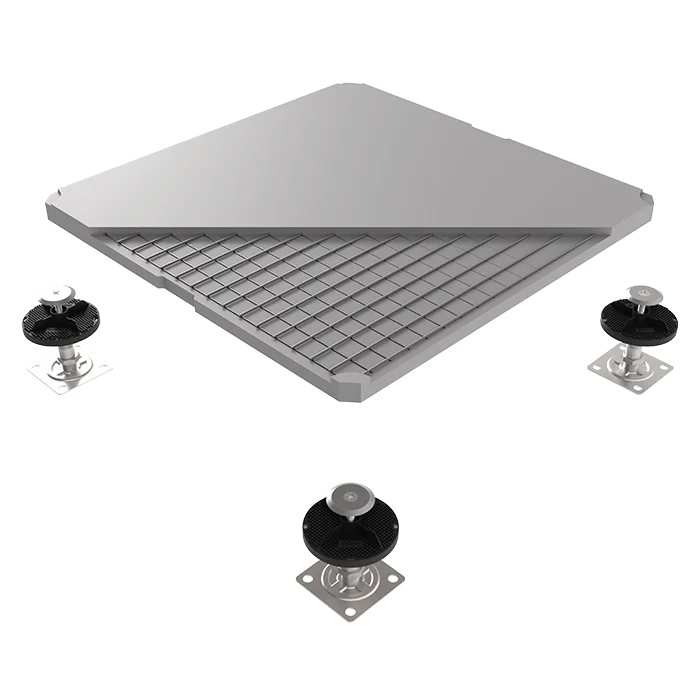
A stringer is a horizontal structural member — typically a galvanized cold-rolled steel section, 25-30 mm in height and 600 mm in length for standard 600 mm x 600 mm panel grids — that connects adjacent pedestal heads to form a continuous rigid grid beneath the floor panels. Its primary function is load distribution: when a concentrated load is applied to one panel, the stringer transfers a portion of that load to neighboring pedestals, reducing the peak stress on any single pedestal and panel edge.
Without stringers, each panel carries its load independently — the four corners of one panel rest on four pedestal heads, and if one of those heads is slightly low or the panel edge is slightly weak, there is no alternative load path. With stringers, the grid behaves as a continuous surface: a load on one panel is shared across multiple panels through the stringer connections, improving both the ultimate load capacity and the deflection performance of the system.
Q2: What is the difference between bolted and stringerless systems?
In a bolted stringer system, each stringer is mechanically fastened to the pedestal head using a bolt, set screw, or spring-clip mechanism that creates a rigid, non-slip connection. The bolted connection prevents the stringer from disengaging under lateral or seismic loads, and it creates a moment-resisting joint that transfers bending forces between the stringer and the pedestal head. Bolted stringers are required by code in seismic zones (ASCE 7-22 SDC D and above) and in all Tier III and Tier IV data center specifications.
In a stringerless system, panels rest directly on the pedestal heads with no horizontal connecting members between pedestals. The panel itself acts as the horizontal bracing element, transferring shear between adjacent pedestal heads through friction and gravity alone. The advantage is faster installation — typically 15-20% faster than a bolted stringer grid — and lower material cost. The disadvantage is reduced load-sharing capability and zero lateral resistance: any horizontal force on the panel grid must be resisted by the panel-to-pedestal friction alone, which is insufficient under seismic loading or heavy rolling loads.
Q3: When is a stringerless system acceptable?
A stringerless system is acceptable when three conditions are simultaneously met: the facility is in a non-seismic region (ASCE 7 SDC A or B), the concentrated load on any single panel does not exceed EN 12825 Class 2 (500 kg), and the floor plenum does not serve as a pressurized air distribution chamber. These conditions typically align with light office applications — general open-plan workspace with modular furniture, low-density cable routing, and ceiling-based air conditioning.
The moment any one of these conditions is not met, a stringerless system becomes a liability. A data center in a non-seismic region still needs bolted stringers because the concentrated loads from server racks and UPS cabinets exceed Class 2, and the plenum must maintain pressurization for underfloor air distribution. An office in a seismic region still needs bolted stringers even with light loading, because the stringerless grid cannot resist lateral acceleration. The Cement Raised Access Floor system is available in both stringerless and bolted configurations, but we consistently recommend the bolted option for any application where the additional 8-12% material cost is recoverable through reduced long-term maintenance and higher load performance.
Q4: Does adding stringers increase the floor's load rating?
Yes, but not in the way most specifiers assume. Adding bolted stringers does not change the panel's concentrated load rating — that is a property of the panel itself, tested by pressing a 50 mm x 50 mm steel stamp through the panel surface until failure. What stringers change is the effective load distribution across the floor grid. In a stringerless system, a concentrated load at the center of a panel edge (the weakest point) is carried by that panel alone. In a bolted stringer system, the same load is shared between the loaded panel and the adjacent panel through the stringer bending connection, reducing the peak stress on the loaded panel by approximately 20-30%.
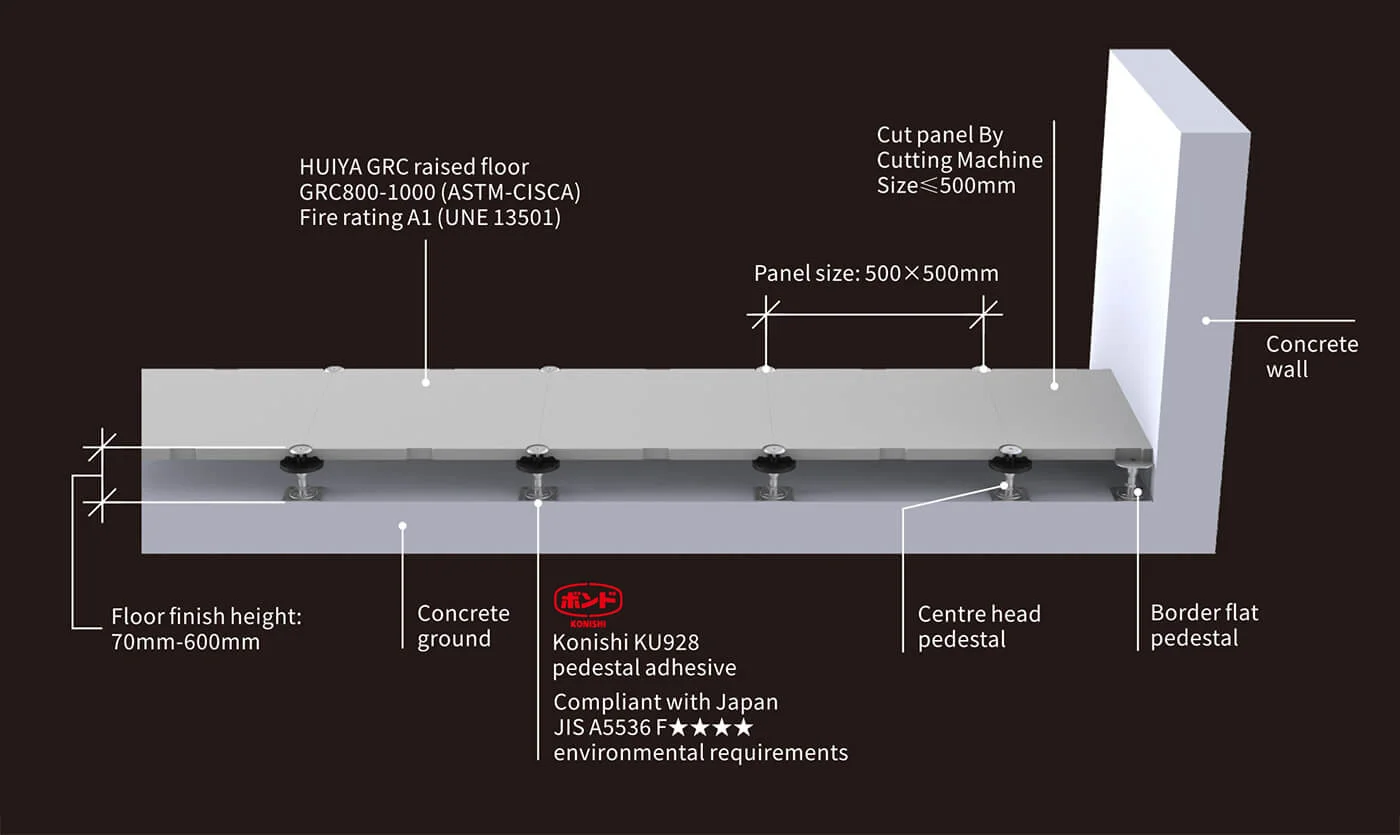
This means that a floor system with Class 3 panels (1,000 kg concentrated load) and bolted stringers will effectively support heavier equipment than the same Class 3 panels on a stringerless grid — not because the panel is stronger, but because the stringer redistributes load away from the weakest point. For this reason, the HUIYA GRC raised access floor with bolted stringers achieves a system-level performance equivalent to one load class higher than its panel rating alone would suggest.
Q5: What about stringerless floors with "gravity clips" — are those equivalent to bolted stringers?
No. Gravity clips (also called anti-lift clips or retention clips) are small metal brackets that hook over the pedestal head and snap into a slot on the panel edge. They prevent the panel from lifting off the pedestal under vertical acceleration — a critical function in seismic zones — but they do not create a horizontal structural connection between pedestals. A panel with gravity clips is still a stringerless panel: it is retained against lift-off but it does not share load with adjacent panels. Do not confuse clip retention with stringer bracing. As explained in the Facilities Net raised floor component comparison reference, clip retention addresses vertical displacement; stringer bracing addresses horizontal load distribution — two distinct mechanisms that serve two distinct purposes.
Q6: What installation tolerances apply to stringer systems?
Stringer installation tolerance is governed by two parameters. Pedestal head alignment: the tops of all pedestal heads at stringer connection points must be level within +/-1.0 mm over any 3 m x 3 m bay. If pedestal heads are out of level by more than 1.0 mm, the stringer will be forced to bend to connect them, introducing preload into the grid that reduces its effective load capacity. Stringer length tolerance: stringers must be manufactured to +/-0.5 mm of nominal length. A stringer that is 0.8 mm too long will bow when forced between two pedestal heads, creating a lateral force that pushes the pedestals apart and gradually loosens the anchor connections over time.
The installation sequence matters: pedestals must be set, leveled, and anchored before any stringers are placed. Stringers are then laid between pedestal heads and bolted in sequence, working from the center of each bay outward to the perimeter. This sequence ensures that any cumulative tolerance error is distributed evenly to the perimeter rather than concentrated at a single point.
Q7: How much does a bolted stringer system add to the project cost?
Bolted stringers add 15-25% to the understructure material cost compared to a stringerless configuration, and they add 10-15% to the installation labor cost due to the additional handling and fastening time. On a typical 1,000 m2 office project, the stringer premium works out to approximately USD 8-15 per m2 of installed floor area. Against a total raised floor installed cost of USD 60-100 per m2, the stringer increment is 10-15% of total project cost.
This premium is rarely justified for light-office, non-seismic applications. It is always justified for data centers, seismic zones, and any facility where the plenum serves as a pressurized air distribution chamber — because the cost of a single panel failure under load (emergency replacement, potential equipment damage, SLA penalties) exceeds the stringer premium for the entire floor area by a factor of 5-10.
Q8: Can stringers be retrofitted to an existing stringerless floor?
Technically yes, but it is rarely practical. Retrofitting stringers requires removing every panel, installing stringers between existing pedestal heads, and re-laying every panel. The labor cost approaches 40-50% of the original installation cost because the removal and reinstallation of panels in an occupied space — particularly one with active cabling in the plenum — is slower and more risk-laden than new installation. In most cases, it is more cost-effective to specify bolted stringers from the outset and accept the 10-15% premium, rather than face a retrofit scenario where the cost of adding stringers approaches half the cost of replacing the entire floor system.
The one scenario where retrofit makes sense is when a facility is being upgraded from general office to data center use and the existing pedestals are compatible with bolted stringer connections. If the pedestal heads have pre-drilled bolt holes or spring-clip receivers, stringers can be added during the fitout conversion without replacing the understructure.
Q9: What maintenance do stringer systems require?
Properly installed bolted stringer systems require virtually zero maintenance under normal conditions. The galvanized steel construction resists corrosion in dry plenum environments, and the bolted connections do not loosen under static loading. Two scenarios do require attention: facilities with persistent plenum humidity above 70% RH may develop surface corrosion on stringers over 10-15 years, which can be addressed with a cold-galvanizing spray coating applied during a scheduled floor maintenance cycle. And facilities in seismic zones should include a bolt-torque verification step in their post-earthquake inspection protocol — checking that stringer bolts remain at the specified torque after a seismic event.
Stringerless systems have no stringer maintenance by definition, but they have a different maintenance concern: the panel-to-pedestal friction joint that replaces the stringer can degrade over time as gaskets compress and panel edges wear. In high-traffic areas, panels on stringerless grids may develop increased deflection after 5-8 years as the friction joint loosens, requiring panel reset and gasket replacement — a maintenance activity that bolted stringer systems do not need.
Q10: How do I decide between stringer types for my next project?
The decision is driven by three variables: seismic risk, loading intensity, and plenum function. If the site is in a seismic region (SDC C or higher), bolted stringers are mandatory — this is a code requirement, not a design preference. If the concentrated load on any panel exceeds Class 2 (500 kg), bolted stringers are strongly recommended even in non-seismic zones because the load-sharing benefit reduces the risk of panel failure under heavy equipment. If the plenum is pressurized for underfloor air distribution, bolted stringers are recommended because they prevent panel-edge gap opening that degrades plenum pressurization efficiency.
If none of these conditions apply — non-seismic, light loading, ceiling-based air — a stringerless system is a perfectly valid and cost-effective choice. The GRC Raised Floor with its cement fiber and steel mesh core is available in both configurations, and the choice between stringerless and bolted should be made on engineering merit, not on the assumption that "more steel is always better." It is not. More steel is better when the application demands it; it is wasted cost when it does not.
Stringer Type Comparison
| Parameter | Bolted Stringer | Stringerless |
|---|---|---|
| Load distribution | Shared across adjacent panels via stringer bending | Each panel carries load independently |
| Concentrated load capacity | Effective system rating +1 class above panel rating | Limited to panel rating alone |
| Lateral resistance | Full moment-resisting grid | Friction only — zero structural resistance |
| Seismic qualification | Meets ASCE 7 SDC D+ / BSL requirements | Not permitted in seismic zones |
| Plenum pressurization | Maintains seal under load — panel joints stay closed | Panel-edge gap opening under heavy loads degrades seal |
| Installation speed | Baseline (100%) | 15-20% faster |
| Material cost premium | +15-25% vs. stringerless understructure | Baseline (lowest) |
| Maintenance | Virtually zero; post-seismic bolt torque check | Gasket replacement / panel reset at 5-8 year intervals |
Both stringer types must comply with the EN 12825 understructure requirements for raised access floors, which specify minimum stringer cross-section dimensions, steel grade (minimum S250GD per EN 10346), and galvanized coating thickness (minimum 20 microns per EN ISO 1461). Compliance is verified through the same load testing protocol that qualifies the complete floor system — stringers are not tested in isolation but as part of the integrated panel-pedestal-stringer assembly.
